
Nyheter
2026-09-16
Making the Case for Nature-Based Solutions: Why Economic Valuation Matters
Making the Case for Nature-Based Solutions: Why Economic Valuation Matters
One of the biggest challenges facing municipalities today is not understanding the value of nature-based solutions, it is making that value count in decision-making.
How can investments in wetlands, urban forests, or green infrastructure compete with roads, housing developments, or technical infrastructure when budgets are tight? How can long-term environmental and social benefits be communicated in ways that support implementation rather than remaining ambitious policy goals?
These are some of the questions being explored in the Nordlocal project funded by the Nordic Council of Ministers. Within the project, the Natural Resources Institute Finland (Luke) leads the work on economic valuation of nature-based solutions, bringing together research on how economic evidence can support better local decision-making.
Among the researchers contributing to this work are Professor Liisa Tyrväinen, an internationally recognised expert on ecosystem services and the economic value of urban green spaces, and doctoral researcher Leo Raivonen, whose research focuses on the economic valuation of wetland restoration. Together with colleagues at Luke, they are reviewing current research, identifying knowledge gaps, and exploring how economic valuation can become a practical tool for municipalities across the Nordic region.
At the European Forum on Urban Forestry (EFUF) in Malmö in May of this year, Liisa Tyrväinen presented some of the latest evidence on the economic benefits of nature-based solutions. Her presentation carried an important message: economic valuation is not about putting a price on nature. It is about making nature’s benefits visible in decisions where they have traditionally been overlooked.
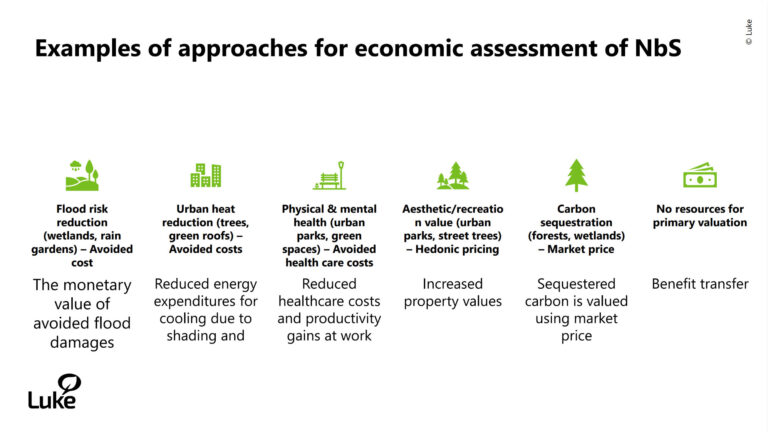
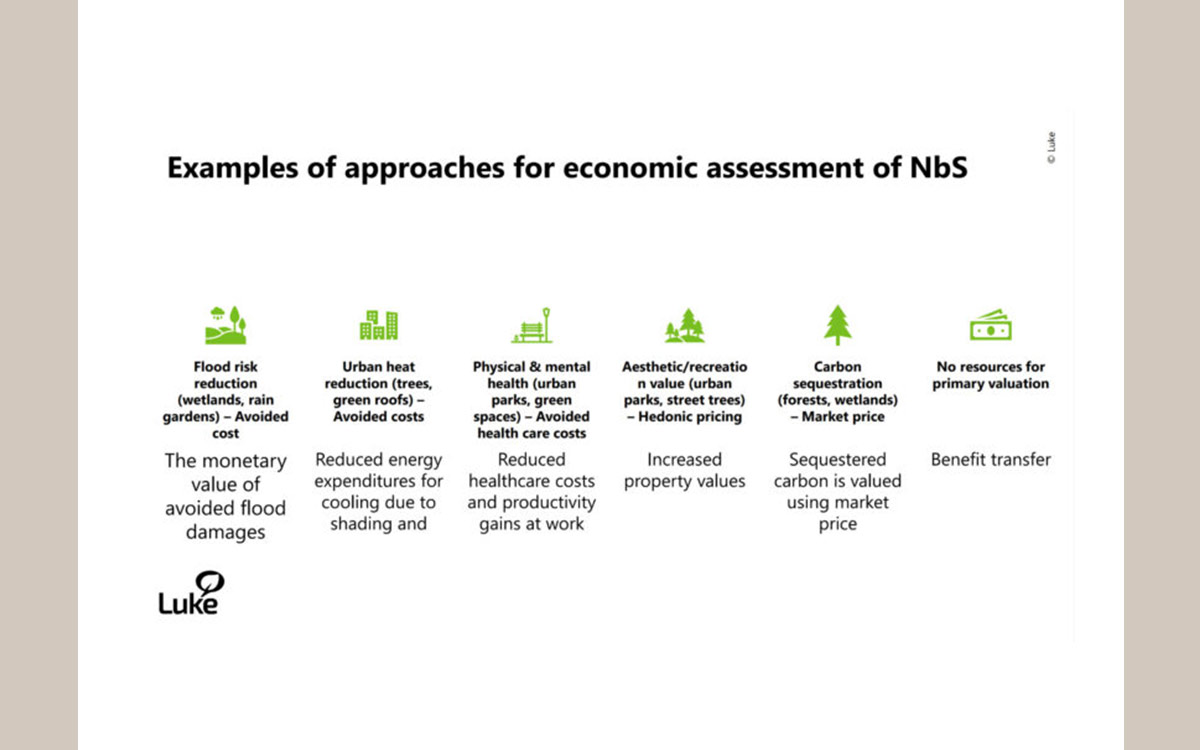
Economic valuation does not rely on a single method. Different ecosystem services require different approaches depending on the type of benefit being assessed. (Source: Liisa Tyrväinen, EFUF 2026)
Why economic valuation?
Municipal planners rarely question whether nature creates value. The challenge is that many of its benefits are difficult to measure and compare with conventional infrastructure investments.
Flood protection, cleaner water, improved public health, increased biodiversity and better recreational opportunities often fall under different municipal departments, making it difficult to build a coherent investment case. Economic valuation can help by providing a common framework for assessing the benefits and costs that occur across sectors.
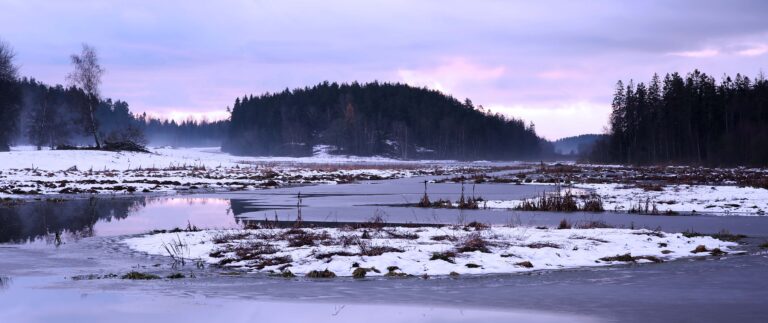
Wetlands are nature-based solutions that can reduce flood risks while improving water quality, photo Ekologigruppen
By translating ecosystem services into economic terms where robust valuation is possible, municipalities can incorporate a broader range of benefits into cost-benefit analyses, investment appraisals and long-term planning. The ambition should be to capture as many relevant ecosystem service values as possible, while recognising that current knowledge and methods do not yet allow all of them to be reliably quantified or monetised. Economic valuation therefore does not replace ecological or social arguments, but complements them by making more of nature’s benefits visible in financial and political decision-making.
As Tyrväinen emphasised during her presentation, economic valuation should be understood as a decision-support tool serving more comprehensive decision-making, not as an attempt to define the total value of nature.
Different benefits require different methods
One of the strongest messages from Luke’s work is that there is not only one way of valuing nature-based solutions. Different ecosystem services require different approaches.
Avoided-cost methods can estimate savings from reduced flooding or lower healthcare costs. Hedonic pricing analyses how access to green spaces affects property values. Carbon sequestration can be assessed using market prices, while benefit transfer methods allow municipalities to adapt results from existing studies when conducting local assessments is not feasible.
The choice of method depends entirely on the benefit being assessed, and every method comes with its own assumptions and uncertainties. Rather than producing one definitive number, economic valuation is about building the strongest possible evidence using the most appropriate methods available.
What does the evidence tell us?
Tyrväinen presented several examples showing how economic valuation is already supporting decision-making across Europe.
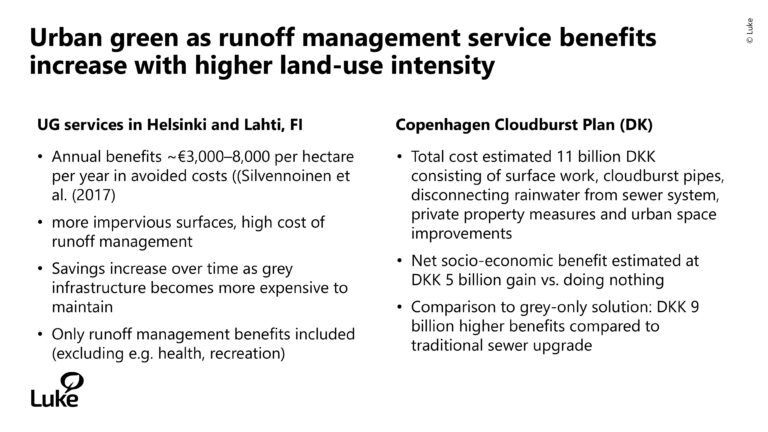
Economic assessments help compare alternative investments. Studies from Helsinki, Lahti and Copenhagen illustrate how avoided costs can be incorporated into planning decisions. (Source: Liisa Tyrväinen, EFUF 2026)
In Helsinki and Lahti, research has estimated that urban green infrastructure can generate annual avoided stormwater management costs of approximately €3,000–8,000 per hectare. These savings arise because vegetation and permeable surfaces reduce the need for expensive grey infrastructure.
Importantly, this figure only reflects one ecosystem service. It does not include benefits related to biodiversity, recreation, climate regulation or public health. Even relatively high estimates therefore represent only part of the overall value.
Another well-known example comes from Copenhagen’s Cloudburst Management Plan, where blue-green infrastructure was compared with expanding the conventional sewer system alone. The analysis estimated that the integrated approach would generate around DKK 9 billion more in socio-economic benefits than a traditional engineering solution, while also delivering multiple additional environmental and social benefits. Compared with taking no action, the project was estimated to produce a net socio-economic benefit of approximately DKK 5 billion.
Economic valuation is increasingly being applied to health as well. A study from Barcelona estimated that expanding urban green infrastructure could prevent more than 30,000 cases of poor mental health, reduce over 16,000 specialist mental health visits, and generate around €45 million in annual healthcare savings.
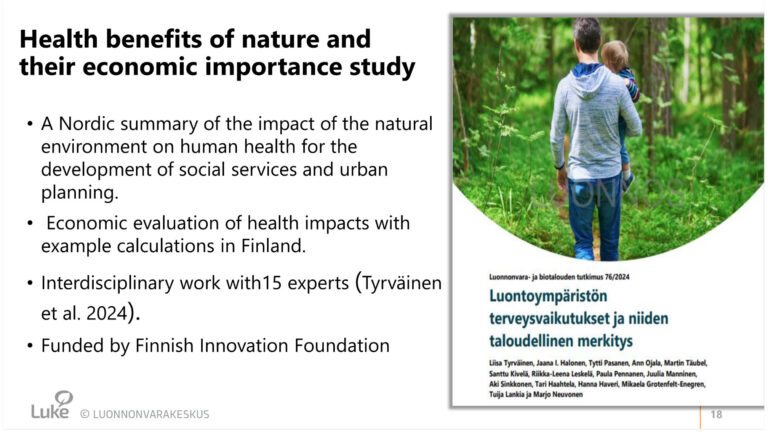
Health benefits are increasingly acknowledged in economic assessments, although the methods are still developing and involve considerable uncertainty. (Source: Liisa Tyrväinen, EFUF 2026)
Together, these examples illustrate how economic evidence can help communicate the broader societal value of investing in nature.
Numbers matter, but they should never stand alone
Perhaps the most valuable part of Tyrväinen’s presentation was not the impressive figures themselves, but the discussion about how they should be interpreted.
Economic valuations are highly sensitive to the assumptions behind them. Results can vary depending on the discount rate, the chosen time horizon, maintenance costs, local environmental conditions and, perhaps most importantly, which ecosystem services are actually included in the analysis.
Some benefits are relatively straightforward to quantify. Flood damage avoided, stormwater management and carbon storage often have well-established methods. Others remain somewhat harder. How should we value biodiversity? What is the monetary value of cultural heritage, sense of place or simply knowing that a species continues to exist? And how should municipalities account for benefits that may not become fully visible for decades?
These questions do not have simple answers.
Luke’s research also highlights that while the number of studies on nature-based solutions has grown rapidly over the past decade, comprehensive economic valuation studies are still relatively few. There are significant knowledge gaps, particularly around biodiversity, cultural ecosystem services and long-term health outcomes. Therofore, a critical interpretation is just as important as the numbers themselves.
From evidence to implementation
Economic valuation alone will not remove the barriers that municipalities face when implementing nature-based solutions. Institutional structures, fragmented budgets, political priorities and organisational silos all influence how decisions are made. A strong cost-benefit analysis does not automatically lead to investment. However, economic evidence can strengthen the conversation. It can help planners communicate across departments, demonstrate long-term societal benefits and broaden discussions beyond individual sectors. In this sense, valuation becomes not only concretizing the values of nature, but also about making invisible benefits visible. That perspective sits at the heart of Luke’s contribution to Nordlocal.
By reviewing existing evidence, developing practical approaches and identifying both the strengths and limitations of current valuation methods, the project aims to give municipalities better tools and more comprehensive data for making informed decisions. It is to ensure that the value nature creates, for climate resilience, health, biodiversity and quality of life, is recognised alongside other investments shaping tomorrow’s communities.

Meadows and nectar-rich plantings provide food and habitat for pollinating insects, which are essential for food production and healthy ecosystems, photo Ekologigruppen
Read more about how to join Nordlocal here: https://traekontoret.dk/nord-local/
Följ vårt arbete för ett grönare samhälle.
Här samlar vi alla våra senaste nyheter, pressmeddelanden och när vi syns i media.
Vill du få våra nyheter direkt till din inkorg?
Håll dig uppdaterad om vårt arbete, aktuella projekt och kommande evenemang.
Prenumerera på vårt nyhetsbrev – det kommer ut cirka fyra gånger per år.
Anmäl dig till nyhetsbrevet här >>
2026-09-16
Kilde: Nord-local
Making the Case for Nature-Based Solutions: Why Economic Valuation Matters
Hvordan kan kommuner synliggøre naturens værdier, når forskellige investeringer konkurrerer om begrænsede ressourcer? Inden for Nordlocal undersøger forskere ved Natural Resources Institute Finland (Luke), hvordan økonomisk værdisætning kan bidrage til bedre beslutninger om naturbaserede løsninger.
I artiklen fortæller vi mere om forskellige metoder til at værdisætte naturens goder – fra klimatilpasning og sundhed til biodiversitet og rekreation – og hvorfor økonomiske tal skal fortolkes med omtanke.
Læs hele blogindlægget her
2026-09-10
Kilde: Grønt Miljø
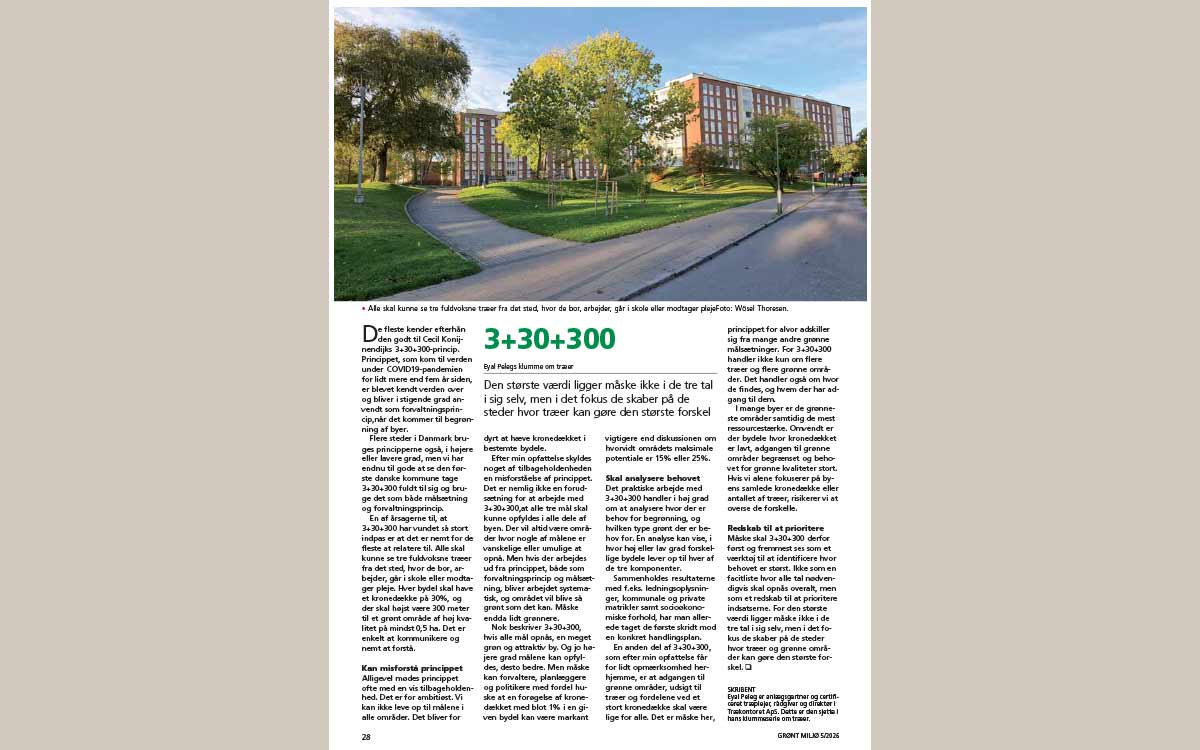
3+30+300 – mere end tre tal
3+30+300-princippet er blevet et internationalt kendt værktøj til at gøre byer grønnere. Men principperne handler ikke om, at alle mål skal opfyldes overalt. De kan i stedet bruges til at identificere, hvor behovet for mere grønt er størst, og prioritere indsatser dér, hvor træer og grønne områder kan gøre den største forskel.
Læs hele artiklen her:
2026-07-24
Kilde: Nord-local
Nordlocal perspectives: what makes nature-based solutions Nordic?
Hvordan påvirker det nordiske klima arbejdet med naturbaserede løsninger?
På den første Nordlocal-workshop diskuterede kommuner fra hele Norden, hvordan klima, lokale forhold og langsigtet forvaltning påvirker arbejdet med naturbaserede løsninger.
Læs hele blogindlægget her.
2026-07-02
Kilde: Event
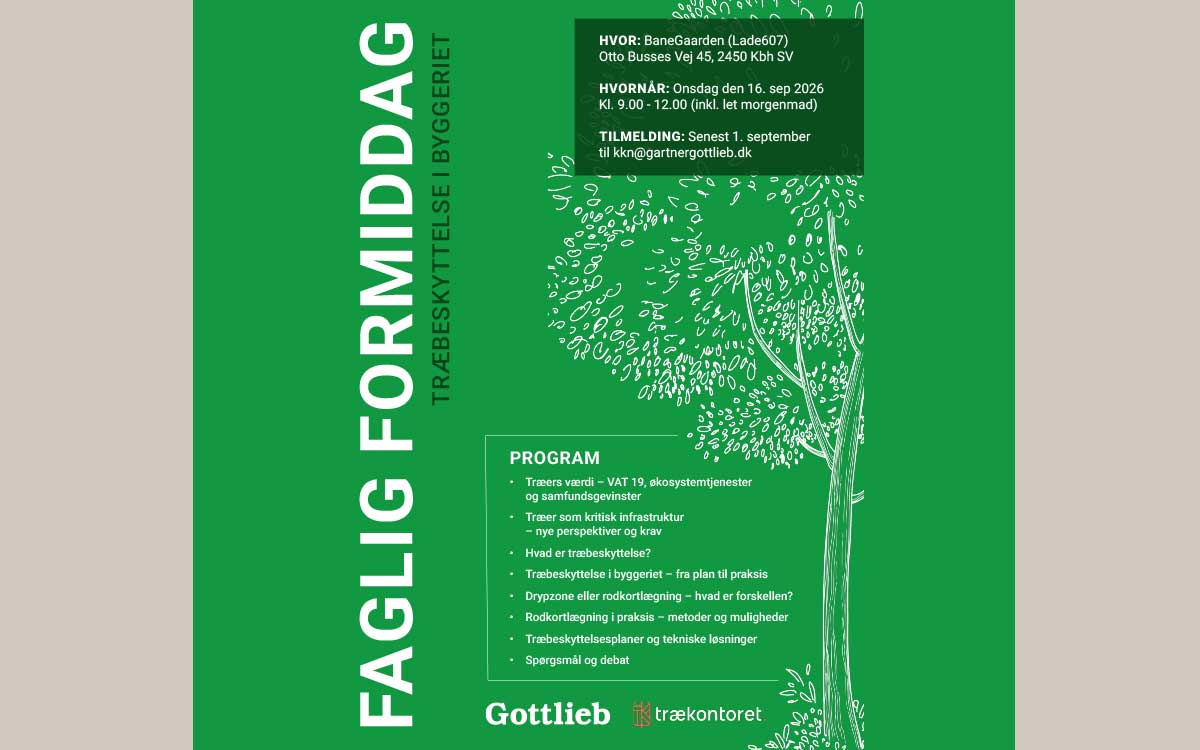
Faglig formiddag om træbeskyttelse i byggeriet
Hvordan sikrer vi, at eksisterende træer bevares bedst muligt i forbindelse med byggeri og anlæg? Sammen med Anlægsgartner Gottlieb A/S inviterer Trækontoret til en gratis faglig formiddag med fokus på træbeskyttelse – fra de første planer til det færdige anlæg.
Vi sætter fokus på træers værdi, træbeskyttelse i praksis, rodkortlægning og de nyeste faglige metoder. Arrangementet henvender sig til alle, der arbejder med træer i relation til byggeri og anlæg.
📅 16. september 2026 | 📍 BaneGaarden, København
Læs mere om programmet og tilmelding
2026-06-24
Kilde: Grønt Miljø
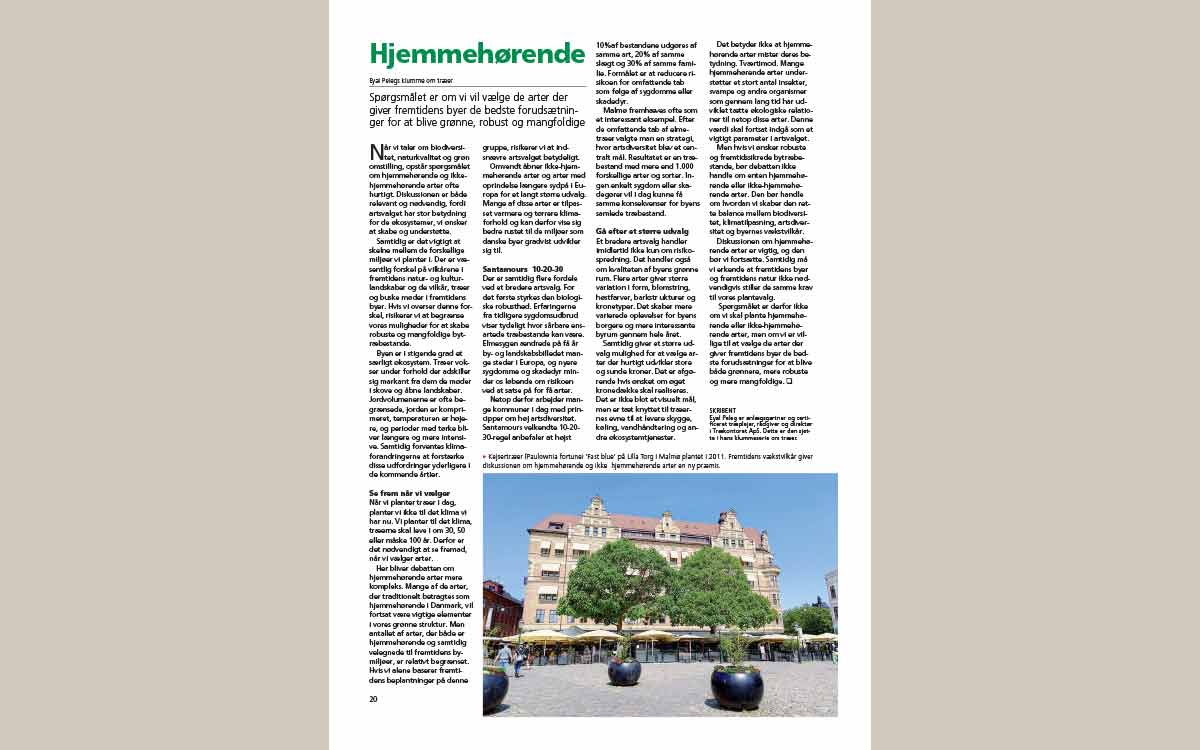
Hjemmehørende – men for hvem?
Når vi planter træer i dag, planter vi ikke kun til nutiden, men til fremtidens byer. I denne klumme sætter Eyal Peleg fokus på debatten om hjemmehørende og ikke-hjemmehørende arter og spørger, om vi er villige til at vælge de arter, der bedst kan sikre grønne, robuste og mangfoldige bymiljøer i et varmere og mere udfordret klima.
Læs hele artiklen her.
2026-05-04
Kilde: Nord-local
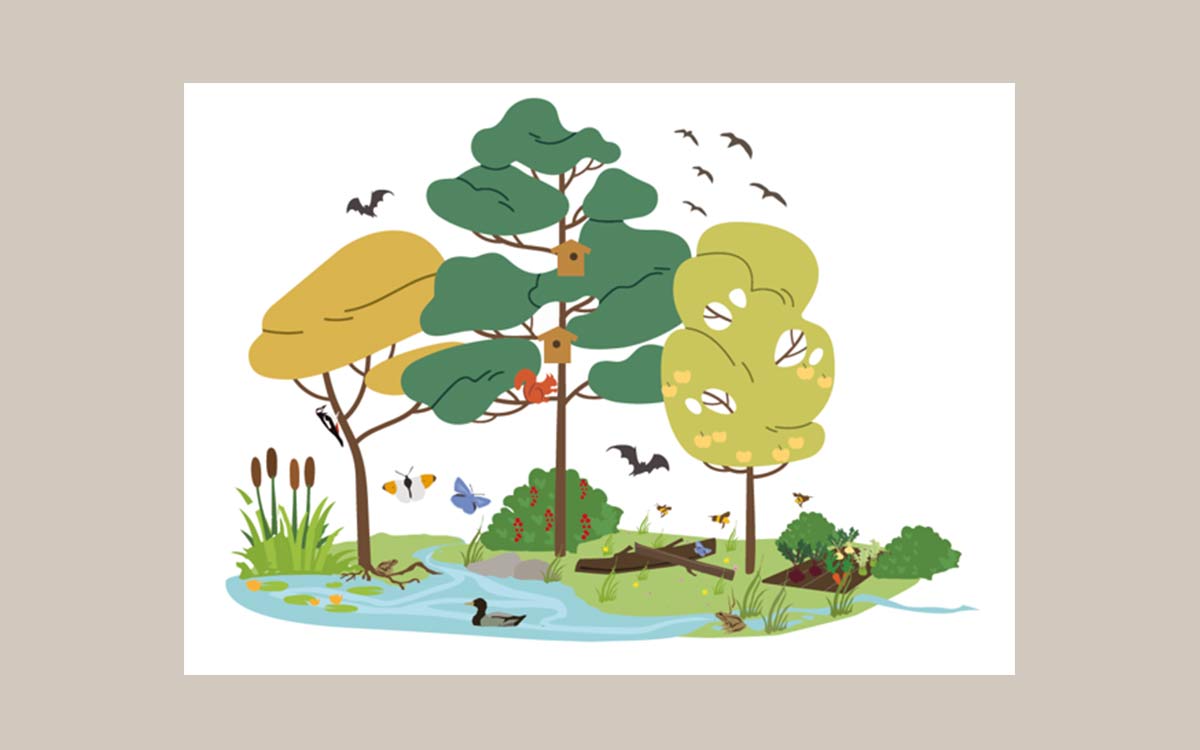
Nordlocal – Scaling Nature-Based Solutions through local Nordic Action
Nordlocal samler kommuner og eksperter fra hele Norden for at gøre det lettere at implementere og opskalere naturbaserede løsninger. Gennem samarbejde, erfaringsudveksling og praktisk afprøvning omsættes viden til konkrete løsninger i lokale miljøer.
Læs hele blogindlægget her.
2026-03-01
Kilde: Grønt Miljø
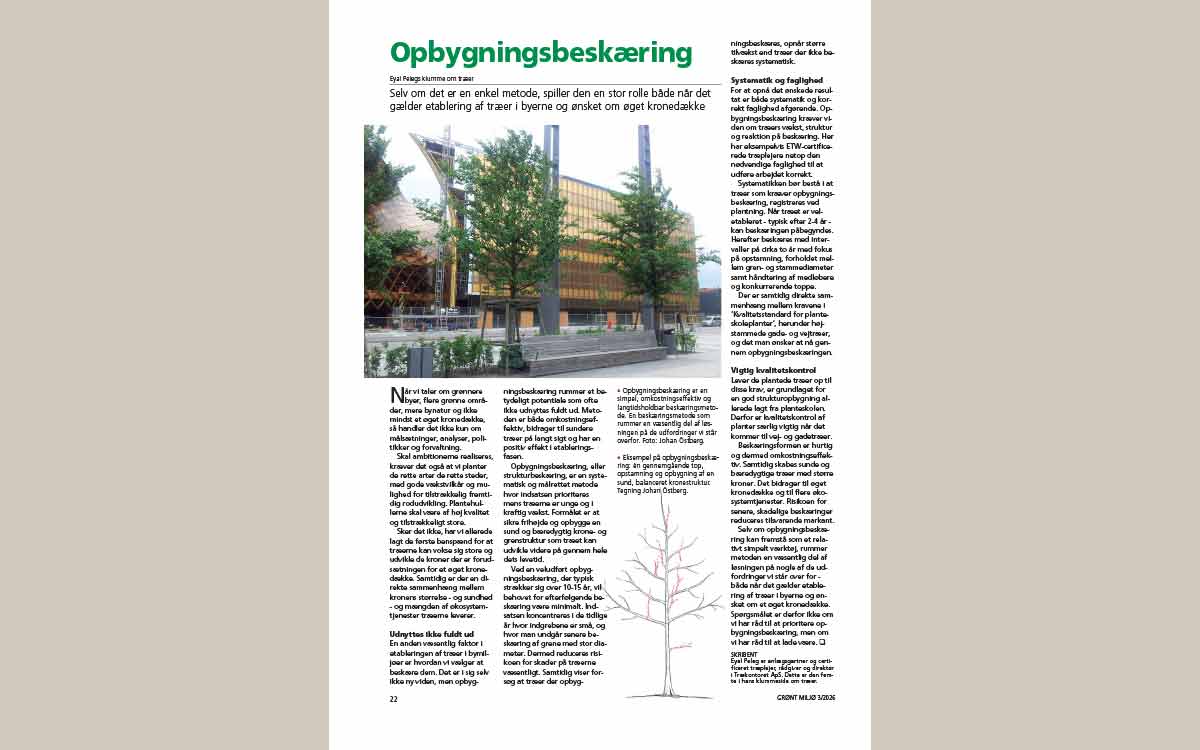
Opbygningsbeskæring: En lille indsats med stor effekt
Vil vi have større, sundere træer og mere kronedække i byerne, begynder arbejdet længe før træerne er fuldt udvoksede. I denne klumme forklarer Eyal Peleg, hvorfor opbygningsbeskæring er et af de mest effektive redskaber til at sikre robuste træer med stærke kronestrukturer. En målrettet indsats i de første leveår kan reducere fremtidige problemer og samtidig styrke træernes vækst og økosystemtjenester.
Læs hele artiklen her.
2026-02-09
Kilde: Pressmedelande
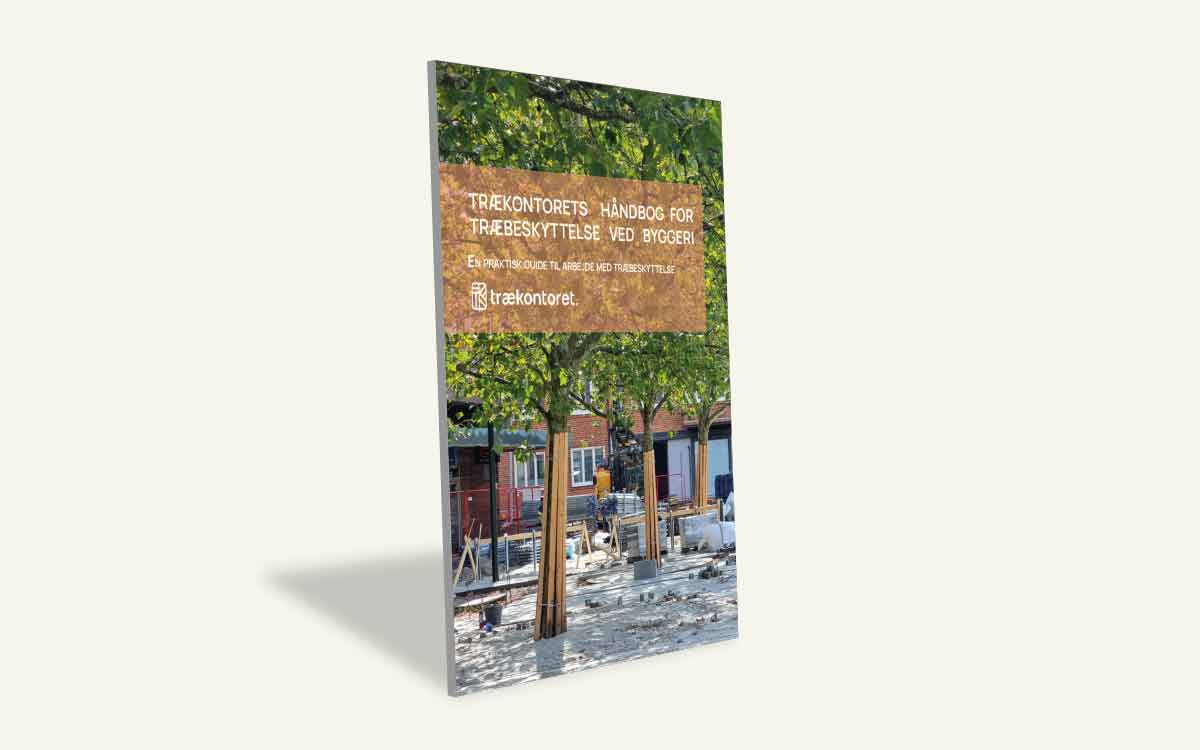
Trækontoret lancerer en ny håndbog om træbeskyttelse ved byggeri
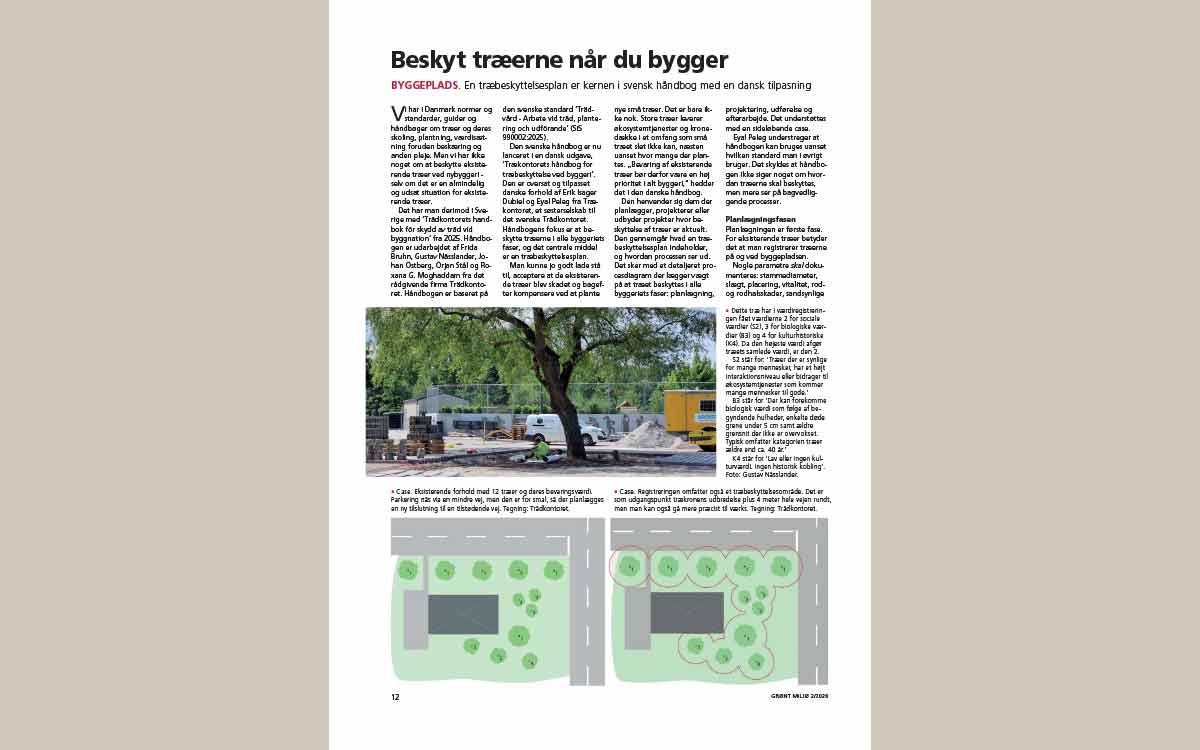
Trækontoret lancerer en ny håndbog om træbeskyttelse ved byggeri. Håndbogen er udarbejdet med afsæt i erfaringer og principper fra den svenske standard SS 990002:2025 – Trädvård – Arbete vid träd – Skydd av träd vid planering og utførelse samt den svenske håndbog, og er tilpasset danske forhold, praksis og begreber.
Håndbogen er et praktisk redskab for alle, der arbejder med planlægning og udførelse af bygge- og anlægsprojekter i nærheden af træer, og håbet er, at den kan være til inspiration for, hvordan principper for træbeskyttelse kan omsættes til konkrete løsninger i praksis.
Håndbogen kan downloades gratis her
2026-02-01
Kilde: Grønt Miljø
Ny håndbog sætter fokus på træbeskyttelse ved byggeri
Når byggeprojekter planlægges, er eksisterende træer ofte blandt de mest sårbare elementer på byggepladsen. En ny dansk udgave af Trækontorets håndbog for træbeskyttelse ved byggeri giver konkrete værktøjer til at beskytte træer gennem hele byggeprocessen. I artiklen gennemgås håndbogens centrale principper, herunder træbeskyttelsesplaner, bevaringsvurderinger og afgrænsning af træbeskyttelsesområder.
Læs hele artiklen her.
2026-02-01
Kilde: Grønt Miljø
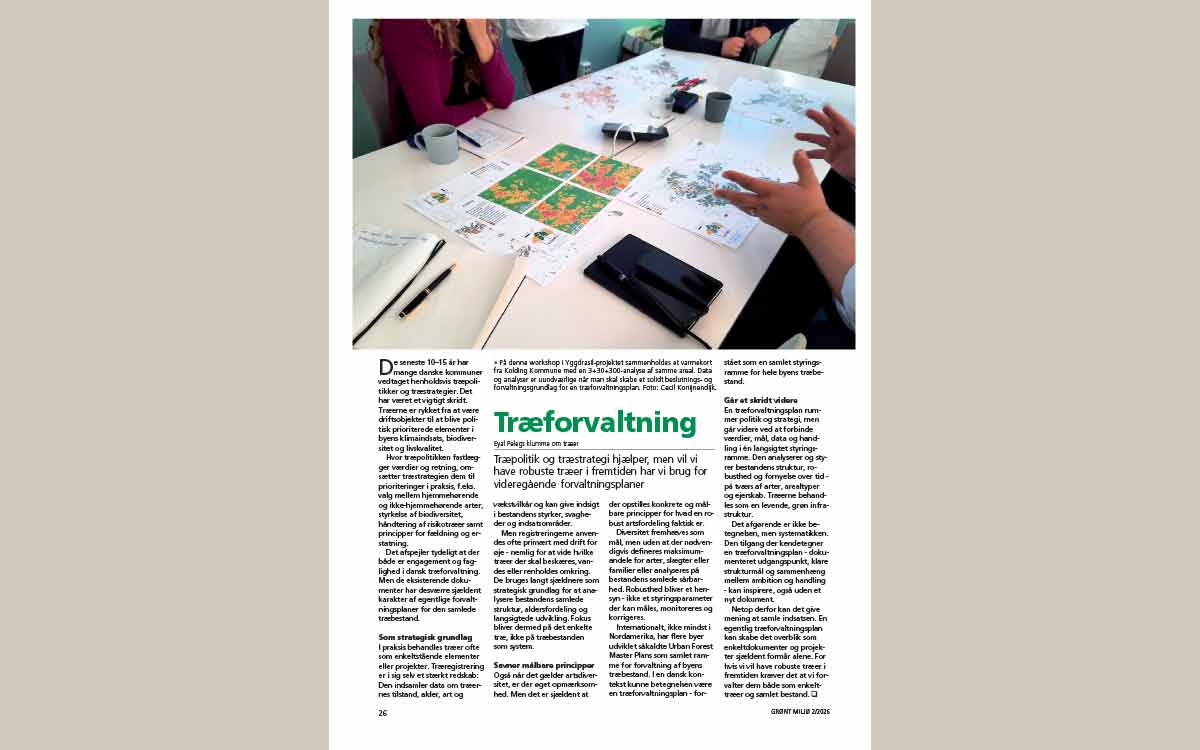
Fra træstrategi til træforvaltningsplan
Mange kommuner har i dag træpolitikker og træstrategier, men er det nok til at sikre robuste træbestande på lang sigt? I denne klumme argumenterer Eyal Peleg for, at fremtidens træforvaltning kræver en mere helhedsorienteret tilgang, hvor træerne betragtes som en samlet grøn infrastruktur. Læs om, hvorfor træforvaltningsplaner kan blive det næste vigtige skridt for danske kommuner.
Læs hele artiklen her.
2026-01-01
Kilde: Grønt Miljø
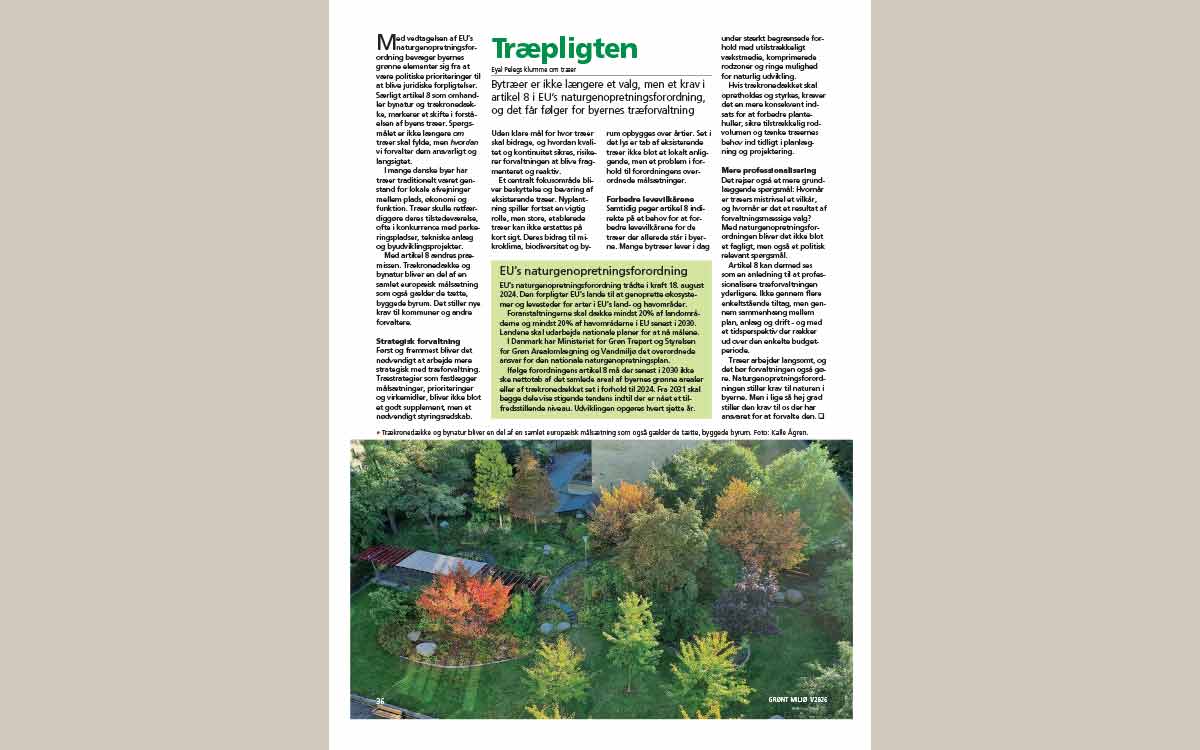
EU gør bytræer til en forpligtelse
Med EU’s naturgenopretningsforordning er bytræer ikke længere blot et politisk valg, men en del af en juridisk forpligtelse. I denne klumme ser Eyal Peleg nærmere på, hvad artikel 8 betyder for kommuner og andre træforvaltere, og hvorfor strategisk planlægning, beskyttelse af eksisterende træer og bedre vækstvilkår bliver afgørende for fremtidens bynatur.
Læs hele artiklen her.
2025-09-03
Kilde: Pressmedelande
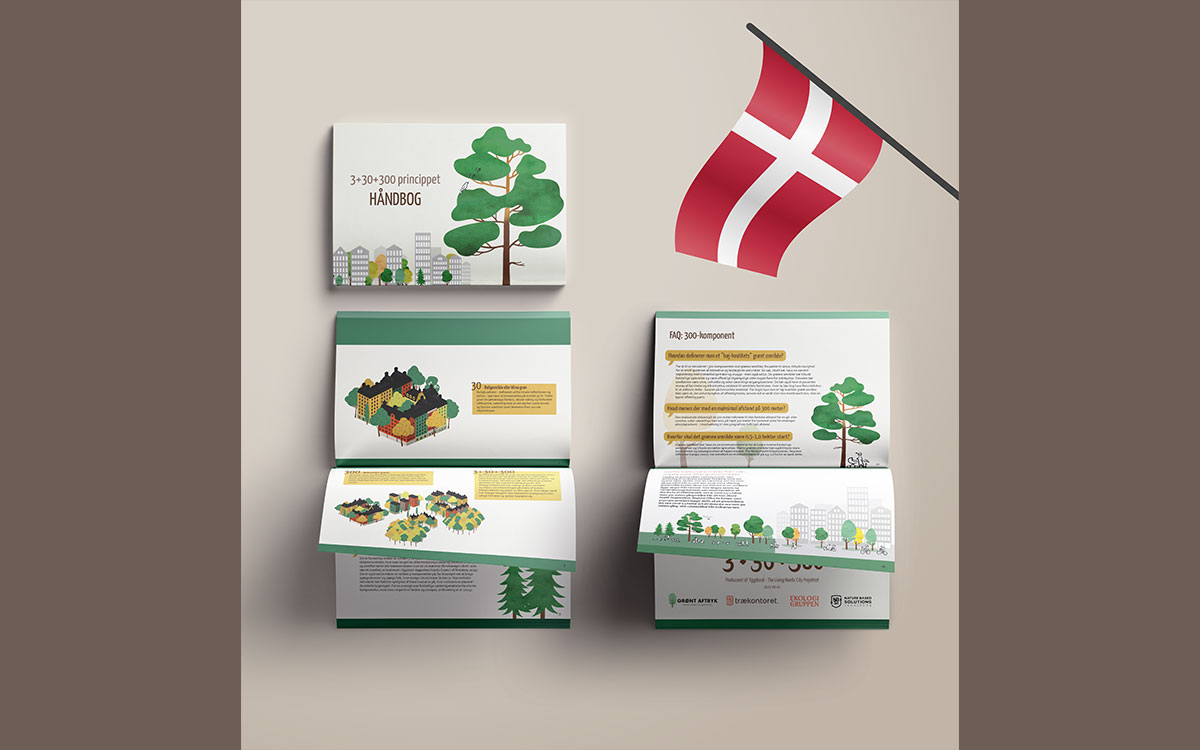
Håndbogen for 3+30+300-princippet findes nu på dansk!
Håndbogen for 3+30+300-princippet, udviklet inden for Yggdrasil-projektet, er nu endelig oversat til dansk!
Princippet er et konkret redskab til at arbejde strategisk med træer i byen – fra planlægning og politik til praktisk anvendelse. Det bygger på tre klare retningslinjer:
🌳 Mindst 3 træer fra hver bolig 🌳 30 % kronedække i hvert byområde 🌳 300 meter til nærmeste grønne område.
2025-09-01
Kilde: Pressemeddelelser
Velkommen, Trækontoret Danmark!
Vi er utrolig stolte af at kunne annoncere, at Trækontoret fra den 1. september 2025 officielt etablerer sig i Danmark! Vi er allerede en førende aktør inden for træforvaltning i Sverige og Norge, og nu ser vi frem til at bidrage til at skabe grønnere og sundere byer i Danmark.
Det danske kontor, Trækontoret ApS, vil blive ledet af den nye administrerende direktør, Eyal Peleg. Sammen med vores stærke nordiske team vil Eyal og det danske team tilbyde kvalificeret rådgivning inden for professionel træforvaltning og -planlægning.
2025-08-01
Kilde: Grønt Miljø
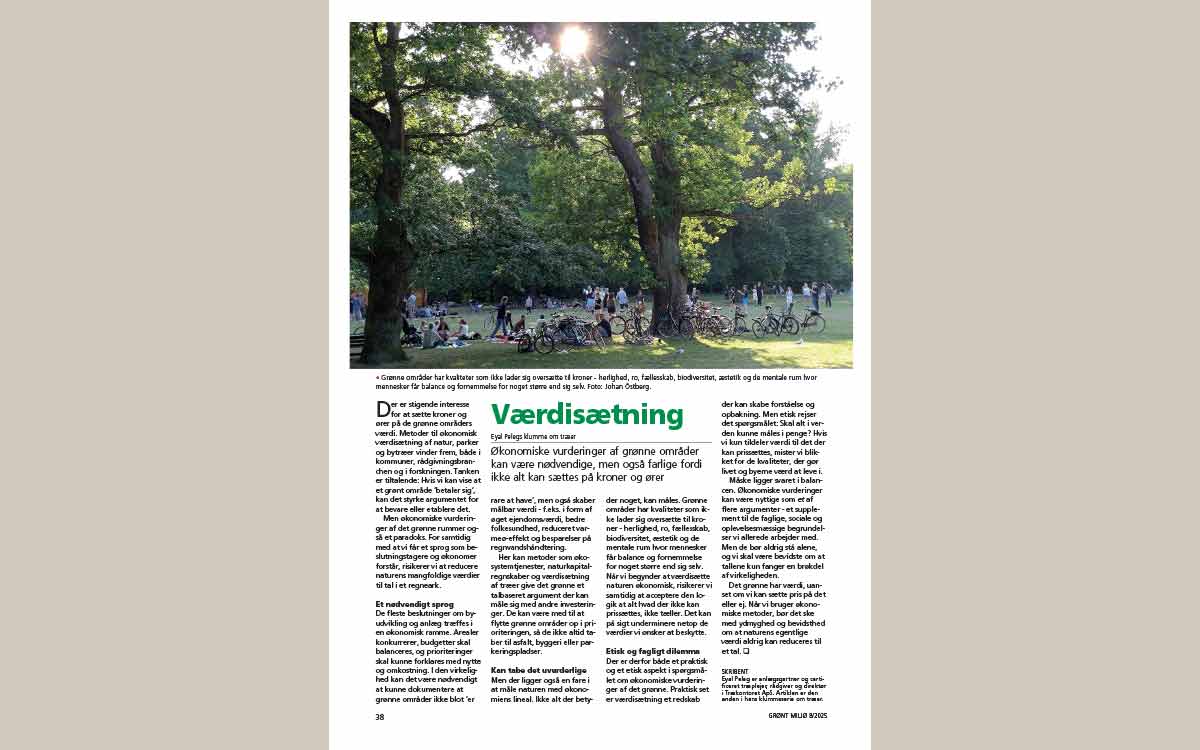
Værdisætning af det grønne – nødvendigt redskab eller farlig forenkling?
Kan naturens og byens grønne områder måles i kroner og øre? I denne klumme undersøger Eyal Peleg fordelene og udfordringerne ved økonomisk værdisætning af parker, træer og natur. Artiklen diskuterer, hvordan økonomiske argumenter kan styrke grønne investeringer – men også hvorfor nogle af naturens vigtigste værdier aldrig kan reduceres til et tal.
Læs hele artiklen her.
2025-07-01
Kilde: Grønt Miljø
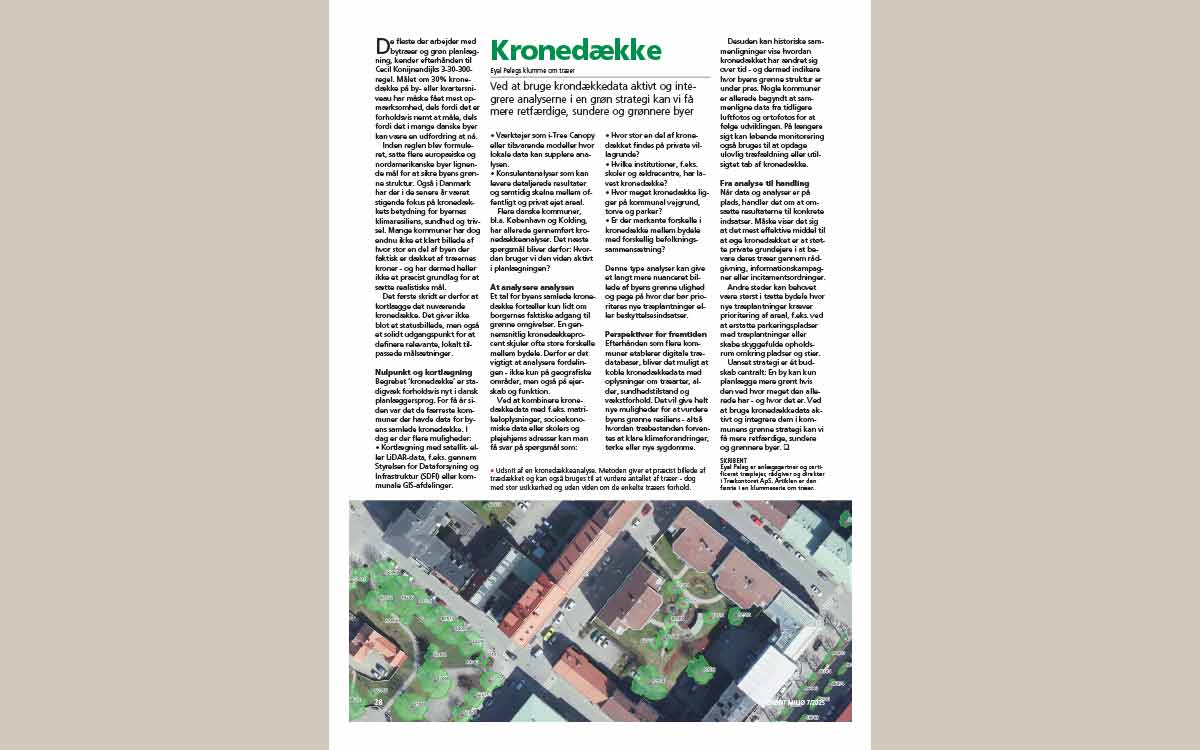
Kronedække: Nøglen til grønnere og mere retfærdige byer
Hvordan kan kommuner bruge viden om træernes kronedække til at skabe sundere, mere klimarobuste og mere lige bymiljøer? I den første artikel i en ny klummeserie om træer sætter anlægsgartner, certificeret træplejer og direktør i Trækontoret ApS, Eyal Peleg, fokus på kronedækkets betydning for fremtidens byplanlægning. Læs om, hvordan data og analyser kan omsættes til konkrete grønne indsatser – fra kortlægning til handling.
Læs hele artiklen her.
Making the Case for Nature-Based Solutions: Why Economic Valuation Matters
One of the biggest challenges facing municipalities today is not understanding the value of nature-based solutions, it is making that value count in decision-making.
How can investments in wetlands, urban forests, or green infrastructure compete with roads, housing developments, or technical infrastructure when budgets are tight? How can long-term environmental and social benefits be communicated in ways that support implementation rather than remaining ambitious policy goals?
These are some of the questions being explored in the Nordlocal project funded by the Nordic Council of Ministers. Within the project, the Natural Resources Institute Finland (Luke) leads the work on economic valuation of nature-based solutions, bringing together research on how economic evidence can support better local decision-making.
Among the researchers contributing to this work are Professor Liisa Tyrväinen, an internationally recognised expert on ecosystem services and the economic value of urban green spaces, and doctoral researcher Leo Raivonen, whose research focuses on the economic valuation of wetland restoration. Together with colleagues at Luke, they are reviewing current research, identifying knowledge gaps, and exploring how economic valuation can become a practical tool for municipalities across the Nordic region.
At the European Forum on Urban Forestry (EFUF) in Malmö in May of this year, Liisa Tyrväinen presented some of the latest evidence on the economic benefits of nature-based solutions. Her presentation carried an important message: economic valuation is not about putting a price on nature. It is about making nature’s benefits visible in decisions where they have traditionally been overlooked.
Economic valuation does not rely on a single method. Different ecosystem services require different approaches depending on the type of benefit being assessed. (Source: Liisa Tyrväinen, EFUF 2026)
Why economic valuation?
Municipal planners rarely question whether nature creates value. The challenge is that many of its benefits are difficult to measure and compare with conventional infrastructure investments.
Flood protection, cleaner water, improved public health, increased biodiversity and better recreational opportunities often fall under different municipal departments, making it difficult to build a coherent investment case. Economic valuation can help by providing a common framework for assessing the benefits and costs that occur across sectors.
Wetlands are nature-based solutions that can reduce flood risks while improving water quality, photo Ekologigruppen
By translating ecosystem services into economic terms where robust valuation is possible, municipalities can incorporate a broader range of benefits into cost-benefit analyses, investment appraisals and long-term planning. The ambition should be to capture as many relevant ecosystem service values as possible, while recognising that current knowledge and methods do not yet allow all of them to be reliably quantified or monetised. Economic valuation therefore does not replace ecological or social arguments, but complements them by making more of nature’s benefits visible in financial and political decision-making.
As Tyrväinen emphasised during her presentation, economic valuation should be understood as a decision-support tool serving more comprehensive decision-making, not as an attempt to define the total value of nature.
Different benefits require different methods
One of the strongest messages from Luke’s work is that there is not only one way of valuing nature-based solutions. Different ecosystem services require different approaches.
Avoided-cost methods can estimate savings from reduced flooding or lower healthcare costs. Hedonic pricing analyses how access to green spaces affects property values. Carbon sequestration can be assessed using market prices, while benefit transfer methods allow municipalities to adapt results from existing studies when conducting local assessments is not feasible.
The choice of method depends entirely on the benefit being assessed, and every method comes with its own assumptions and uncertainties. Rather than producing one definitive number, economic valuation is about building the strongest possible evidence using the most appropriate methods available.
What does the evidence tell us?
Tyrväinen presented several examples showing how economic valuation is already supporting decision-making across Europe.
Economic assessments help compare alternative investments. Studies from Helsinki, Lahti and Copenhagen illustrate how avoided costs can be incorporated into planning decisions. (Source: Liisa Tyrväinen, EFUF 2026)
In Helsinki and Lahti, research has estimated that urban green infrastructure can generate annual avoided stormwater management costs of approximately €3,000–8,000 per hectare. These savings arise because vegetation and permeable surfaces reduce the need for expensive grey infrastructure.
Importantly, this figure only reflects one ecosystem service. It does not include benefits related to biodiversity, recreation, climate regulation or public health. Even relatively high estimates therefore represent only part of the overall value.
Another well-known example comes from Copenhagen’s Cloudburst Management Plan, where blue-green infrastructure was compared with expanding the conventional sewer system alone. The analysis estimated that the integrated approach would generate around DKK 9 billion more in socio-economic benefits than a traditional engineering solution, while also delivering multiple additional environmental and social benefits. Compared with taking no action, the project was estimated to produce a net socio-economic benefit of approximately DKK 5 billion.
Economic valuation is increasingly being applied to health as well. A study from Barcelona estimated that expanding urban green infrastructure could prevent more than 30,000 cases of poor mental health, reduce over 16,000 specialist mental health visits, and generate around €45 million in annual healthcare savings.
Health benefits are increasingly acknowledged in economic assessments, although the methods are still developing and involve considerable uncertainty. (Source: Liisa Tyrväinen, EFUF 2026)
Together, these examples illustrate how economic evidence can help communicate the broader societal value of investing in nature.
Numbers matter, but they should never stand alone
Perhaps the most valuable part of Tyrväinen’s presentation was not the impressive figures themselves, but the discussion about how they should be interpreted.
Economic valuations are highly sensitive to the assumptions behind them. Results can vary depending on the discount rate, the chosen time horizon, maintenance costs, local environmental conditions and, perhaps most importantly, which ecosystem services are actually included in the analysis.
Some benefits are relatively straightforward to quantify. Flood damage avoided, stormwater management and carbon storage often have well-established methods. Others remain somewhat harder. How should we value biodiversity? What is the monetary value of cultural heritage, sense of place or simply knowing that a species continues to exist? And how should municipalities account for benefits that may not become fully visible for decades?
These questions do not have simple answers.
Luke’s research also highlights that while the number of studies on nature-based solutions has grown rapidly over the past decade, comprehensive economic valuation studies are still relatively few. There are significant knowledge gaps, particularly around biodiversity, cultural ecosystem services and long-term health outcomes. Therofore, a critical interpretation is just as important as the numbers themselves.
From evidence to implementation
Economic valuation alone will not remove the barriers that municipalities face when implementing nature-based solutions. Institutional structures, fragmented budgets, political priorities and organisational silos all influence how decisions are made. A strong cost-benefit analysis does not automatically lead to investment. However, economic evidence can strengthen the conversation. It can help planners communicate across departments, demonstrate long-term societal benefits and broaden discussions beyond individual sectors. In this sense, valuation becomes not only concretizing the values of nature, but also about making invisible benefits visible. That perspective sits at the heart of Luke’s contribution to Nordlocal.
By reviewing existing evidence, developing practical approaches and identifying both the strengths and limitations of current valuation methods, the project aims to give municipalities better tools and more comprehensive data for making informed decisions. It is to ensure that the value nature creates, for climate resilience, health, biodiversity and quality of life, is recognised alongside other investments shaping tomorrow’s communities.
Meadows and nectar-rich plantings provide food and habitat for pollinating insects, which are essential for food production and healthy ecosystems, photo Ekologigruppen
Read more about how to join Nordlocal here: https://traekontoret.dk/nord-local/

